The Silent Requirement for Trillion-Dollar Tokenization
The XDC Network has rapidly established itself as the premier blockchain for enterprise finance, global trade, and the tokenization of Real-World Assets (RWAs). Initiatives like TradeTrust are proving that the future of global commerce will run on-chain.
But there is a critical piece of the puzzle that is often overlooked in the hype of Web3: Data Pipelines.
Smart contracts execute code, but they are inherently blind to the outside world. Conversely, traditional financial institutions (like banks, exchanges, and accounting firms) are entirely blind to raw blockchain data unless it is perfectly indexed, translated, and served in real-time.
Trillions of dollars in traditional finance simply cannot move onto the XDC Network if institutions cannot reliably track, audit, and verify every single transaction.
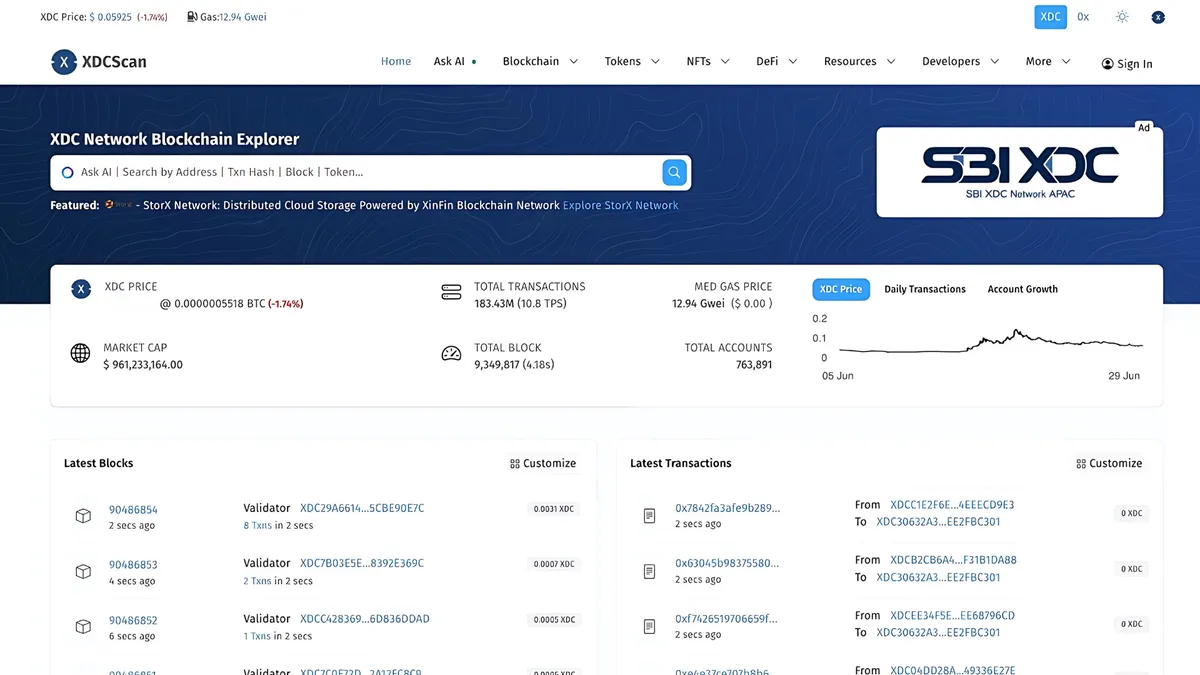
This is where OpenScan steps in. While our community knows us best for our user-facing explorer at XDCScan.io, our true power lies beneath the surface. We are the invisible data backbone powering the next wave of enterprise adoption.
Beyond the UI: Enterprise-Grade Infrastructure
To build an enterprise application, you cannot rely on consumer-grade nodes. You need infrastructure that guarantees uptime, handles massive throughput spikes, and provides forensic-level historical data.
Here is how OpenScan’s backend suite is empowering B2B (Business-to-Business) clients and developers on the XDC Network:
1. XDCRPC: The Foundation of Network Stability
The XDC Network is incredibly fast, boasting 2-second block times and near-zero fees. While this is fantastic for users, it creates a massive engineering challenge for data providers. Processing and indexing thousands of transactions per second requires immense computational power.
Through XDCRPC, our decentralized RPC service, we provide developers and institutions with a direct, ultra-reliable pipeline to the blockchain. We handle the heavy lifting of node synchronization and load balancing, ensuring that enterprise DApps, exchanges, and automated trading bots stay live and responsive, even during peak network congestion.
2. The OpenScan API: Forensic-Level Accounting
When dealing with tokenized real-world assets, “close enough” is not acceptable. Financial institutions require absolute precision for compliance, auditing, and tax reporting.
The OpenScan API allows platforms to programmatically pull full wallet histories, query specific token movements, and trace the lifecycle of an asset across the network instantly. Combined with our CSV Export tools, we have made it possible for Web3 accounting firms and tax software to seamlessly bridge the gap between complex on-chain cryptography and traditional ledger sheets.
3. Supporting Complex Standards (TradeTrust)
Tokenizing a piece of real estate or a global shipping bill of lading requires much more metadata than a standard cryptocurrency transfer. OpenScan’s indexing infrastructure is built to natively understand and track complex smart contract standards, including the architecture required for TradeTrust integration.
By flawlessly indexing this data, we ensure that when an institution verifies a digital document on XDC, the data returned is instantaneous, accurate, and completely tamper-proof.
The Engine for the Future of Finance
As the XDC Network continues to absorb traditional financial markets, the demand for enterprise-grade infrastructure will only multiply.
OpenScan is not just a website for checking your wallet balance. It is a comprehensive suite of APIs, RPCs, and AI-powered analytics designed to meet the rigorous demands of Wall Street and global commerce.
If you are an institution, an exchange, or a developer building the future of tokenized assets on the XDC Network, you need infrastructure that won’t let you down.
Build on the best. Power your DApp with OpenScan.